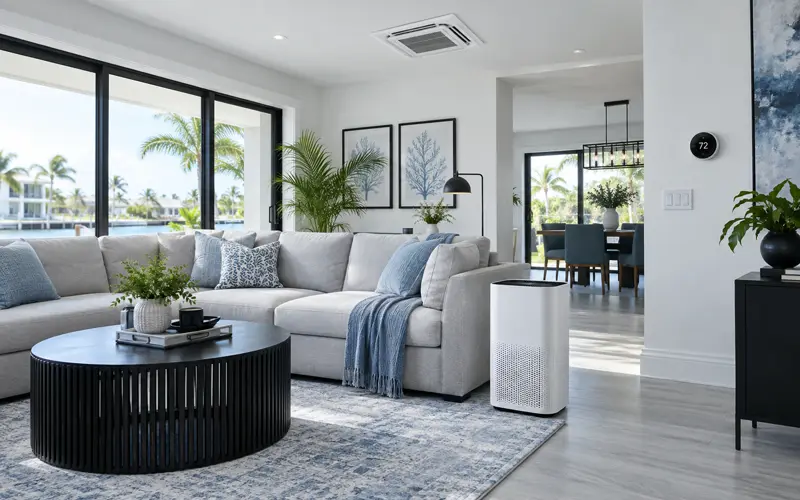
An air purifier and an air conditioner can both make a room more comfortable, but they perform very different jobs. An air conditioner controls temperature and helps reduce humidity, while an air purifier filters particles and certain pollutants from the air. One cannot completely replace the other.
Living in South Florida, I would never consider air conditioning optional. It keeps our home comfortable during the hottest and most humid months. An air purifier serves a separate purpose, especially in rooms where dust, pet dander, smoke, or lingering odors are a concern.
Understanding the difference between an air purifier and an air conditioner makes it easier to decide whether your home needs one appliance or both.
Air Purifier vs. Air Conditioner at a Glance
| Feature | Air Purifier | Air Conditioner |
|---|---|---|
| Primary purpose | Filters indoor air | Cools indoor air |
| Changes room temperature | No | Yes |
| Helps control humidity | No | Yes, while cooling |
| Captures airborne particles | Yes, depending on the filter | Limited filtration |
| Helps with dust and pet dander | Yes | Not its primary purpose |
| Helps with smoke particles | Some models can | No |
| Removes odors | Models with activated carbon may help | No |
| Common placement | Individual room or whole-home system | Window, portable, ductless, or central system |
| Can be used with the other appliance | Yes | Yes |
What Does an Air Purifier Do?
An air purifier pulls indoor air into the unit and passes it through one or more filters. The filtered air is then circulated back into the room. The particles captured depend on the purifier’s filtration system.
A purifier with a high-efficiency particulate filter may help reduce airborne:
- Dust
- Pollen
- Pet dander
- Smoke particles
- Mold spores
- Other fine particles
Some purifiers also contain activated carbon filters that can help reduce certain odors and gases. A particle filter alone generally will not remove gases or odors.
The Environmental Protection Agency’s guidance on residential air cleaners explains that filtration can supplement source control and ventilation, but no air cleaner removes every indoor pollutant. Cleaning, ventilation, moisture control, and removing the source of a contaminant are still important.
An air purifier does not cool a room or lower its humidity. Even though a fan moves air through the machine, the airflow is not comparable to air conditioning.
What Does an Air Conditioner Do?
The primary purpose of an air conditioner is to remove heat from indoor air. As part of the cooling process, air conditioners can also remove some moisture, making a hot and humid room feel more comfortable.
Air conditioning may come from a central HVAC system, a ductless mini-split, a window unit, or a portable unit. Regardless of the design, its main job is temperature control.
An air conditioner can:
- Lower the indoor temperature
- Circulate cooled air
- Remove some humidity while running
- Filter larger debris as air passes through its filter
The amount of moisture removed depends on the equipment, its size, indoor conditions, and how long it runs. An oversized unit may cool a room quickly without operating long enough to remove sufficient humidity. ENERGY STAR air-conditioner sizing guidance explains why matching the unit’s capacity to the room matters for both comfort and moisture removal.
Air conditioning is only one part of maintaining a comfortable home. Window treatments, insulation, ceiling fans, and reducing heat gain can also keep rooms in your home cool without making the system work harder than necessary.
Do Air Conditioners Purify the Air?
An air conditioner filters air, but that does not necessarily make it an air purifier.
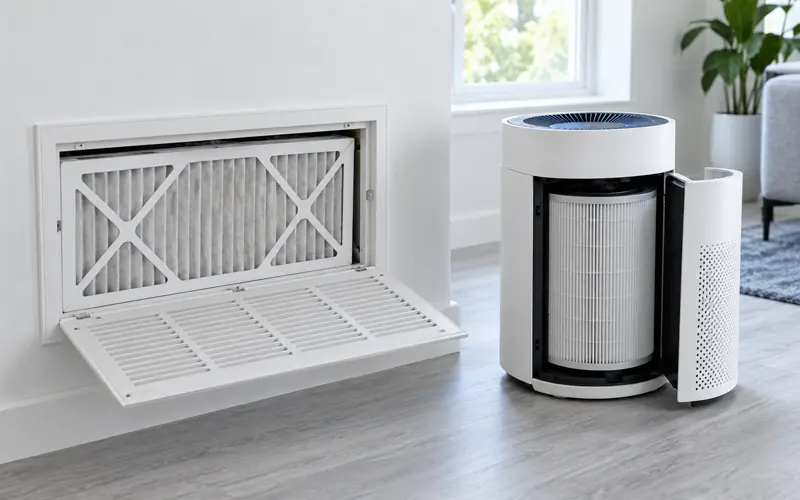
The filter in a standard air-conditioning system often serves two purposes: protecting the equipment from debris and collecting some particles from the air passing through the system. Its effectiveness depends on the type of filter, its condition, and the HVAC system’s capabilities.
A basic filter may catch larger dust particles but allow many smaller particles to continue circulating. A higher-efficiency HVAC filter may collect more particles, although homeowners should use only a filter compatible with their system. A filter that restricts airflow too much can affect performance.
Replacing or cleaning air filters on the recommended schedule supports proper airflow and prevents a heavy buildup of debris. However, even a well-maintained air-conditioning filter does not automatically provide the same targeted filtration as a properly sized air purifier.
When an Air Purifier Makes Sense
An air purifier may be useful when the primary concern involves particles or odors rather than temperature. Common reasons for using one include:
- Pets that shed hair and dander
- Seasonal pollen entering the home
- Dust that quickly settles after cleaning
- Smoke from cooking or outdoor wildfires
- Lingering household odors
- A bedroom or home office that needs additional filtration
Room size is important when choosing a portable purifier. Manufacturers usually provide a recommended room size and a Clean Air Delivery Rate, commonly called CADR. A small purifier may not circulate enough filtered air for a large, open living area.
Filter type also matters. A particle filter targets airborne particles, while activated carbon is used for certain gases and odors. Some models combine both.
Avoid assuming that words such as “sanitizing” or “fresh air” guarantee better performance. The EPA warns that ionizers and ozone-generating air cleaners may produce ozone, which is a lung irritant. Look for clear information about filtration, room coverage, replacement-filter costs, and ozone emissions before buying.
When an Air Conditioner Makes Sense
Choose an air conditioner when heat and humidity are the main problems. An air purifier cannot lower the temperature, make a hot Florida room comfortable, or replace a properly operating cooling system.
Air conditioning is the more appropriate choice when:
- Indoor temperatures are uncomfortably high
- Humidity rises while the home is closed
- Sleeping is difficult because of the heat
- Electronics or household materials need a climate-controlled environment
- The entire home requires consistent cooling
An air conditioner may remove some airborne particles through its filter, but cleaner air is not its primary function. Likewise, an air purifier may circulate air, but it will not provide meaningful cooling.
Do You Need an Air Purifier and an Air Conditioner?
Many homes can benefit from using both because the appliances address different concerns. The air conditioner manages heat and some humidity, while the purifier provides additional filtration in the rooms where it is needed most.
For example, a central air conditioner could cool the entire home while a portable purifier operates in a bedroom, living room, or space where pets spend the most time. I would be more likely to place a purifier in the rooms our dogs use regularly rather than expect one small unit to filter every room in the house.
Using both appliances does not eliminate the need for regular cleaning habits that reduce dust and irritants. Vacuuming, washing bedding, controlling moisture, using exhaust fans, and addressing leaks or mold at the source remain important.
Homeowners comparing different filtration systems may find it useful to see how a whole-room air-purification system performed in a real home. The right option ultimately depends on the size of the space, the pollutants of concern, ongoing filter costs, and how much filtration the home already receives through its HVAC system.
The simplest way to decide is to identify the actual problem. Choose an air conditioner for heat and humidity. Choose an air purifier for additional filtration. Use both when indoor temperature and air quality need separate solutions.