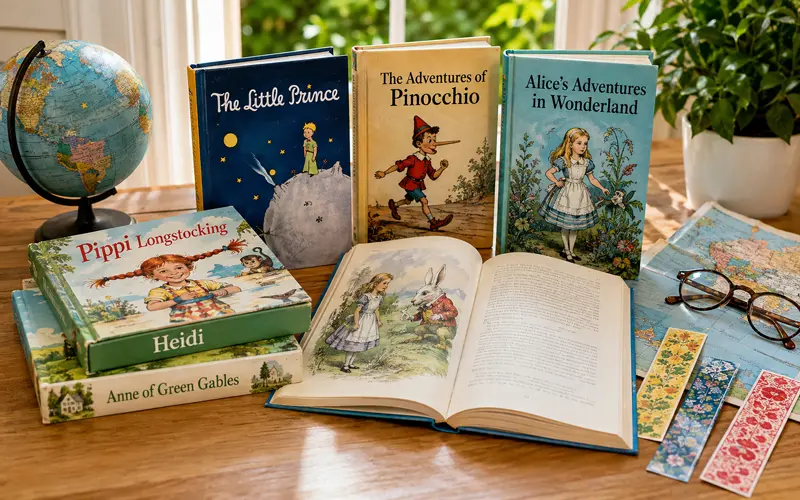
The most translated children’s books have traveled far beyond the countries and languages in which they were originally written. Stories such as The Little Prince, The Adventures of Pinocchio, and Alice’s Adventures in Wonderland have been translated into hundreds of languages, introducing generations of children to the same unforgettable characters.
I was an avid reader when I was young, moving from Little House on the Prairie to Sweet Valley High and almost anything else I could find. I still love reading today, whether I am listening to an audiobook while driving or settling in with my Kindle. Discovering how widely some childhood favorites have traveled makes these familiar stories even more interesting.
What Is the Most Translated Children’s Book?
The Little Prince by Antoine de Saint-Exupéry is generally recognized as the most translated children’s book and the most translated nonreligious literary work in the world. The book’s official website celebrated its 600th translation in 2024.
Translation totals are not always as straightforward as they appear. Some sources count languages and dialects separately, while others combine editions, regional variations, and adaptations. Totals may also refer to an individual book, a collection of stories, or an entire series. For that reason, this is a collection of 10 of the most translated children’s books rather than a definitive ranking.
| Book or Collection | Author | Original Language | Reported Translation Reach |
|---|---|---|---|
| The Little Prince | Antoine de Saint-Exupéry | French | 600 translations |
| The Adventures of Pinocchio | Carlo Collodi | Italian | Approximately 240–260 languages |
| Alice’s Adventures in Wonderland | Lewis Carroll | English | 174 languages |
| Andersen’s Fairy Tales | Hans Christian Andersen | Danish | Andersen’s works appear in more than 160 languages |
| The Gruffalo | Julia Donaldson | English | More than 100 languages and dialects |
| Harry Potter series | J.K. Rowling | English | 85 languages |
| Pippi Longstocking | Astrid Lindgren | Swedish | 80 languages |
| Winnie-the-Pooh | A.A. Milne | English | More than 70 languages |
| Heidi | Johanna Spyri | German | More than 70 languages |
| Anne of Green Gables | L.M. Montgomery | English | At least 36 languages |
1. The Little Prince by Antoine de Saint-Exupéry
First published in 1943, The Little Prince follows a young traveler who leaves his tiny asteroid and visits several planets before arriving on Earth. His conversations with the adults and creatures he meets explore friendship, loneliness, love, responsibility, and the way people see the world.
Although it is presented as a children’s story, many of its observations are written for adults as much as children. That ability to speak to readers at different stages of life may help explain why it has connected with so many cultures.
Its short chapters and thoughtful themes also make it a good book for families to read together. Younger readers can enjoy the unusual characters and illustrations, while older children and adults may notice the deeper meaning behind the story.
2. The Adventures of Pinocchio by Carlo Collodi
Before Pinocchio became closely associated with animated movies, he was the mischievous wooden puppet at the center of Carlo Collodi’s Italian novel. The story was initially published in installments beginning in 1881 and was released as a book in 1883.
Published estimates vary, but The Adventures of Pinocchio has reportedly been translated into approximately 240 to 260 languages. It became the first work of Italian children’s literature to achieve widespread international recognition.
The original book is also darker and more complex than many modern adaptations. Pinocchio repeatedly faces the consequences of impulsive decisions as he learns about honesty, responsibility, courage, and compassion.
3. Alice’s Adventures in Wonderland by Lewis Carroll
Lewis Carroll’s Alice’s Adventures in Wonderland has never been out of print since its publication in 1865. The story follows Alice through a world filled with disappearing cats, hurried rabbits, unusual tea parties, and characters who make their own rules.
According to research highlighted by the State Library Victoria, Carroll’s Alice books have been translated into 174 languages. Translating the story is particularly challenging because so much of its humor depends on English wordplay, riddles, poems, and deliberately illogical conversations.
The fantastical setting appeals to children, but the clever language and absurdity give adults plenty to enjoy. It is also a fun choice for comparing different illustrated editions because artists have interpreted Wonderland in dramatically different ways.
4. Andersen’s Fairy Tales by Hans Christian Andersen
Hans Christian Andersen wrote more than 150 fairy tales, including The Little Mermaid, The Ugly Duckling, The Emperor’s New Clothes, The Snow Queen, and The Princess and the Pea.
The University of Southern Denmark reports that Andersen’s works have been translated into more than 160 languages. This total covers his body of work rather than one specific collection, but his fairy tales remain among the most internationally recognized stories written for children.
Many of the original tales are more emotional and sometimes much darker than the modern versions children may know. Reading the original story after seeing a movie adaptation can lead to interesting conversations about how stories change for different audiences.
5. The Gruffalo by Julia Donaldson
Published in 1999 and illustrated by Axel Scheffler, The Gruffalo is much newer than most books on this list. It follows a clever mouse who invents a frightening creature to avoid becoming dinner for several forest animals—only to encounter the supposedly imaginary Gruffalo.
The official Gruffalo website reports that the story has been translated into more than 100 languages, including Māori, Thai, Russian, Scots, and Latin.
The story’s rhyming language, repetition, humor, and memorable illustrations make it especially enjoyable to read aloud. Those same rhymes can make the book difficult to translate because translators must preserve the rhythm and humor without changing the story.
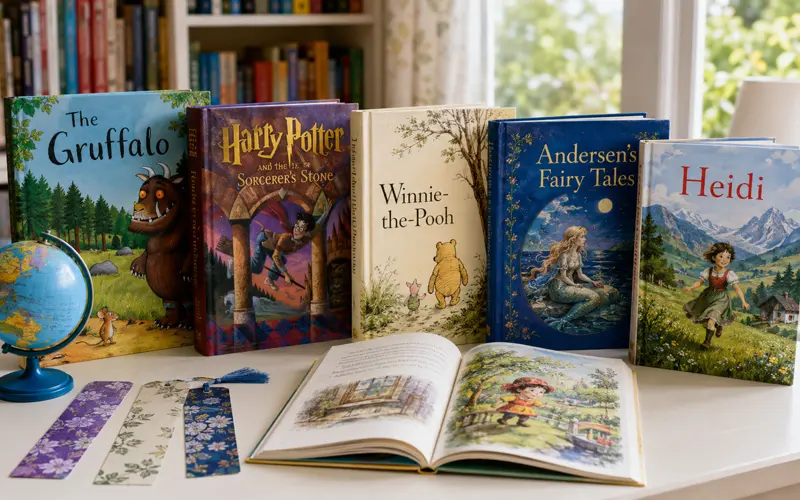
6. The Harry Potter Series by J.K. Rowling
The seven-book Harry Potter series follows an orphaned boy who discovers that he is a wizard and begins attending Hogwarts School of Witchcraft and Wizardry. What starts as a magical school adventure gradually develops into a much larger story about friendship, courage, prejudice, power, and sacrifice.
The series has been translated into 85 languages and has sold more than 600 million copies worldwide. Translators faced the challenge of adapting invented spells, character names, creatures, jokes, and wordplay while keeping the magical world recognizable.
The books also offer a natural way for children to grow into a series. The stories become longer and more mature as Harry and his friends get older, allowing many readers to develop alongside the characters.
7. Pippi Longstocking by Astrid Lindgren
Pippi Longstocking lives independently in Villa Villekulla with a horse and a monkey. She is extraordinarily strong, confident, unconventional, and rarely concerned about behaving the way adults expect.
According to the official Astrid Lindgren website, Pippi Longstocking reached its 80th language in 2025 when it was translated into Nigerian Pidgin. Recent translations have also included Yiddish, Scottish Gaelic, Silesian, Alsatian, and Karelian.
Children often enjoy Pippi because she turns the ordinary rules of childhood upside down. Her independence can also encourage conversations about confidence, kindness, imagination, and when breaking a rule is very different from hurting someone.
8. Winnie-the-Pooh by A.A. Milne
A.A. Milne’s Winnie-the-Pooh was published in 1926 and inspired by the stuffed animals belonging to his son, Christopher Robin Milne. The stories follow Pooh, Piglet, Eeyore, Tigger, and their friends through gentle adventures in the Hundred Acre Wood.
The book has been translated into more than 70 languages. One of its most notable editions is the 1958 Latin translation, Winnie Ille Pu, which became the first foreign-language book to appear on The New York Times Best Seller list.
The stories appear simple, but their humor, wordplay, and observations about friendship give them lasting appeal. Pooh’s loyal friendships and Eeyore’s gloomy but accepted personality also make the stories useful for talking with children about emotions and appreciating people who see the world differently.
9. Heidi by Johanna Spyri
Published in 1880, Heidi tells the story of a young orphan sent to live with her grandfather in the Swiss Alps. Her cheerful personality gradually changes the people around her, although she later struggles when she is taken away from the mountains to become a companion to a girl named Clara.
The Swiss government’s official overview of Heidi’s history reports that the novel has been translated into more than 70 languages and adapted into more than 15 films.
Its descriptions of mountain life, family relationships, friendship, homesickness, and belonging have helped it connect with readers far beyond Switzerland.
10. Anne of Green Gables by L.M. Montgomery
Anne of Green Gables begins when siblings Marilla and Matthew Cuthbert plan to adopt a boy to help with their farm but instead receive Anne Shirley, an imaginative and talkative red-haired orphan.
First published in 1908, the novel has been translated into at least 36 languages and has sold more than 50 million copies. Anne’s international popularity is especially strong in Japan, where the book has influenced generations of readers and inspired animation, tourism, and numerous editions.
Anne makes mistakes, speaks her mind, and frequently allows her imagination to carry her away. She is also intelligent, determined, loyal, and eager to belong, qualities that continue to make her relatable more than a century after the book was published.
Introducing Children to Classic Books
A famous title is not automatically the right book for every child. Reading level, interests, attention span, and the particular translation or edition can all affect how much a child enjoys the story.
Illustrated and abridged editions can make older books more approachable for younger readers. Audiobooks are another option, especially when unusual names or older writing styles make the printed version difficult to follow. Bilingual editions allow children who are studying another language to compare familiar passages without attempting an entire book without support.
Reading does not have to be the only activity. A book can inspire art projects, imaginative play, cooking, travel research, or a family movie night. Families can also continue learning away from the page with educational board games for kids and families or age-appropriate educational toys that encourage learning through play.
During school breaks, reading one chapter each day can become part of a larger list of fun things to do in the summer. Letting children select the book, edition, or accompanying activity can make reading feel like something they chose instead of another assignment.
These translated children’s books show how a memorable character or meaningful story can travel across borders and remain relevant for generations. Choosing even one unfamiliar title from the list offers children a chance to experience a story that has already connected with readers around the world.