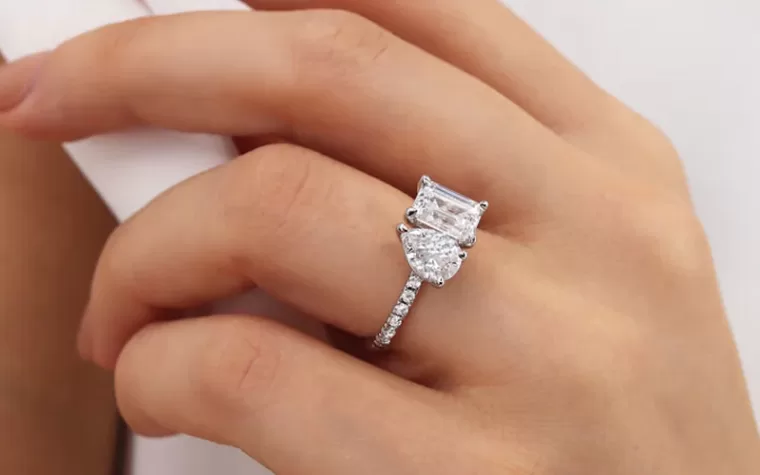
Rethinking how we mark commitment
An engagement ring is a small object with an outsized emotional role. It is worn daily, noticed in quiet moments more often than public ones, and over time it becomes part of the wearer rather than a separate adornment. For decades, the idea of what an engagement ring should look like was narrowly defined. One central stone, elevated and solitary, was expected to carry the full weight of the promise it represented.
That expectation has softened. As relationships themselves become more nuanced, jewellery has followed, offering designs that feel less declarative and more reflective. Dual stone engagement ring designs sit comfortably within this shift. They do not reject tradition but gently expand it, allowing room for interpretation, balance, and personal meaning.
Early in any exploration of this style, it becomes clear that these rings appeal to people who are curious rather than decisive. They are often drawn to the idea of rings symbolising two souls, not as a grand statement but as a quiet acknowledgment of partnership.
Why two stones invite deeper meaning
There is something instinctively engaging about a ring with two focal points. The eye moves between the stones, noticing how they sit together, how they differ, and how they relate. This interaction mirrors the nature of a relationship itself. Symbolically, two stones can represent two individuals choosing to share a life. Unlike a single stone, which can suggest one central ideal, a dual stone design implies dialogue. Each element has presence. Neither is reduced to a supporting role.
What makes this symbolism especially compelling is its flexibility. Some people see the stones as equal partners. Others view them as past and future, or individuality and togetherness. For many, the idea of rings symbolising two souls feels intuitively right, even if they never articulate it aloud. The meaning does not need to be fixed. It can grow and shift as the relationship does.
A design with deep historical roots
Although these rings feel well-suited to modern sensibilities, their origins are far from recent. In Europe during the late eighteenth century, two stone rings were exchanged as intimate expressions of affection. They were often referred to as toi et moi rings, a phrase that simply means you and me. One of the most widely referenced examples comes from the early nineteenth century, when Napoleon Bonaparte presented a ring set with a diamond and a sapphire to Joséphine de Beauharnais. The stones were placed close together, visually reinforcing the idea of connection. While their relationship was famously complex, the symbolism of the ring endured long after their story faded.
During the Victorian era, jewellery was often layered with meaning. Stones were chosen for their associations, and multiple gemstones were used to convey sentiment, family ties, or hidden messages. Two stone rings fit naturally into this culture of symbolism. They were valued not for extravagance but for what they quietly expressed.
As engagement jewellery became more standardised in the twentieth century, particularly in Western cultures, these designs receded from view. Their return suggests a renewed appreciation for jewellery that tells a personal story rather than following a fixed template.
How design choices affect emotion
One of the reasons dual stone engagement ring designs feel so personal is that small variations can dramatically change their character. The shape is often the first detail people notice. Two identical cuts placed side by side create symmetry and calm. Mixing shapes introduces contrast and a sense of movement, as if the stones are responding to one another.
Color adds another layer of expression. Some rings feature two diamonds with subtle differences in size or tone, creating distinction without disruption. Others pair a diamond with a colored gemstone. A sapphire can suggest depth and continuity, while an emerald may feel expressive and grounded. Softer stones, such as morganite, bring warmth and intimacy.
Two-stone settings also create opportunities to mix gemstones or combine different shapes and sizes. Moissanite is one option for couples who want flexibility in their design at a lower price than comparable diamonds. MoissaniteCo offers moissanite engagement rings in styles that include solitaires and two-stone designs. Moissanite is a distinct gemstone known for its strong durability and colorful fire, making it suitable for everyday wear.
The way the stones are set matters just as much. When they touch or nearly touch, the effect feels close and immediate. When a small gap remains, the design can suggest independence alongside connection. Neither approach carries a universal meaning. Each invites the wearer to interpret it in their own way.
Modern relationships and evolving values
Many people today approach engagement with a sense of realism shaped by lived experience. Relationships often develop over years, marked by shared challenges and mutual growth. Engagement becomes less about beginning a story and more about recognising one that is already unfolding.
Two stone rings align naturally with this perspective. They reflect partnership rather than idealisation. The design acknowledges that love is built from two viewpoints, not one imagined standard. This is why rings symbolising two souls resonate so strongly in contemporary contexts. They feel honest, grounded, and emotionally accurate.
There is also a growing preference for jewellery that feels personal rather than performative. A ring with two stones does not always immediately signal engagement. To some observers, it may simply appear distinctive or thoughtfully designed. That ambiguity appeals to those who value private meaning over public recognition.
Living with a ring that has two centres
From a practical standpoint, people are often surprised by how wearable two stone rings can be. Many sit lower on the finger than traditional single stone designs, which can make them easier to wear daily. The distribution of weight across two stones often creates a sense of balance that feels natural.
Over time, the relationship between wearer and ring tends to deepen. The presence of two stones invites reflection. Some people find that each stone gradually takes on its own significance. One might come to represent a shared milestone, while the other reflects personal growth or a turning point in life.
This evolving meaning is part of what gives the style longevity. The ring does not demand a single interpretation. It adapts as the relationship does, allowing new layers of significance to form quietly.
Cultural layers and shared identity
Jewellery has always been shaped by cultural values, and the renewed interest in two stone designs reflects a broader embrace of individuality and shared identity. Engagement no longer follows a single path, and rings no longer need to look a certain way to feel meaningful. For couples from different backgrounds, two stones can hold particular resonance. Each may reflect a heritage, a family story, or a place that shaped them. In this way, the ring becomes more than a symbol of partnership. It becomes a meeting point of histories.
Even without a defined narrative, many people are drawn to these designs instinctively. There is often a sense that they simply feel right, mirroring how relationships function through dialogue, difference, and shared understanding.
Beyond fashion and fleeting trends
It is easy to label any jewellery style as a trend, something destined to fade as tastes change. Dual stone rings resist that label because their appeal is rooted in human connection rather than novelty. They have appeared in different forms across centuries, resurfacing whenever personal meaning takes precedence over convention.
For readers who are simply curious about engagement jewellery, this style offers a reminder that symbolism does not need to be loud to be powerful. Sometimes, the quiet presence of two stones side by side communicates more than a single flawless centre ever could. In celebrating duality, these rings acknowledge a simple truth. Love is rarely singular. It is built from two lives, two perspectives, and two souls choosing, again and again, to move forward together.