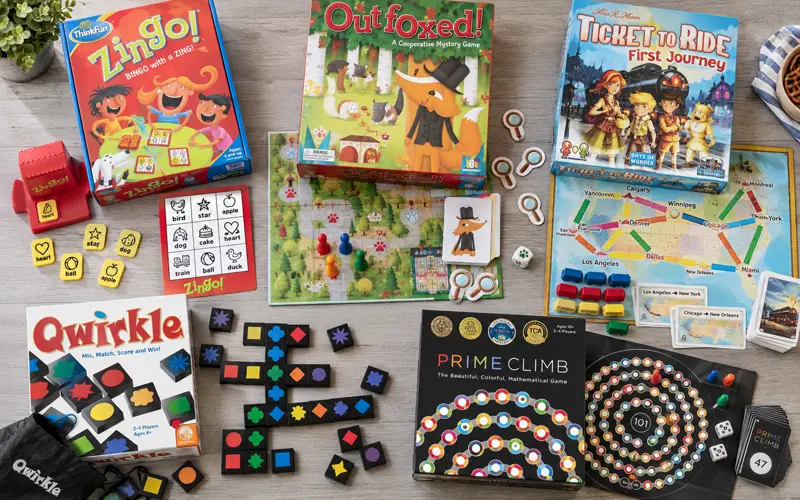
Educational board games for kids can turn family time into an opportunity to practice reading, math, strategy, problem-solving, and social skills without making the experience feel like another school assignment. The right game keeps children interested in playing while naturally encouraging them to think, plan, communicate, and make decisions.
Games can also support skills that extend beyond a particular school subject. The Center on the Developing Child at Harvard University explains that age-appropriate games can help children practice attention, working memory, cognitive flexibility, and self-regulation. Waiting for a turn, remembering rules, changing strategies, and handling disappointment are all valuable parts of playing together.
Just as educational toys benefit young children through hands-on exploration, board games encourage learning through active participation. The best choices are challenging enough to hold a child’s attention but not so difficult that frustration takes over.
Educational Board Games at a Glance
| Game | Recommended Age | Players | Skills Practiced |
|---|---|---|---|
| Sequence for Kids | 3–6 | 2–4 | Matching, strategy, turn-taking |
| Zingo | 4+ | 2–6 | Vocabulary, reading, visual recognition |
| Outfoxed! | 5+ | 2–4 | Deduction, cooperation, attention |
| Sum Swamp | 5+ | 2–4 | Addition, subtraction, number sense |
| Scrabble Junior | 5+ | 2–4 | Spelling, vocabulary, letter recognition |
| Ticket to Ride: First Journey | 6+ | 2–4 | Geography, planning, strategy |
| Qwirkle | 6+ | 2–4 | Patterns, logic, strategic thinking |
| Blokus | 5+ | 2–4 | Spatial reasoning, planning, geometry |
| CATAN Junior | 6+ | 2–4 | Resource management, strategy, decision-making |
| Prime Climb | 10+ | 2–4 | Multiplication, division, prime numbers |
| Trekking Through History | 10+ | 2–4 | History, sequencing, resource management |
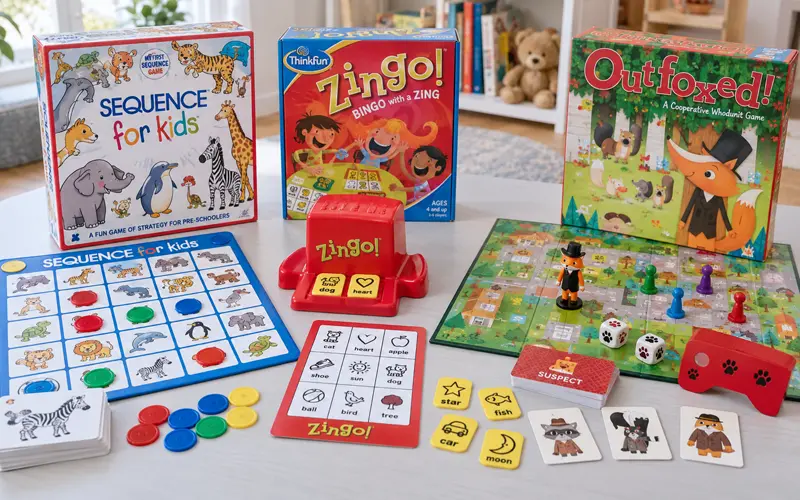
Best Educational Board Games for Preschoolers
Preschool games should have simple rules, colorful pieces, short playing times, and minimal reading requirements. Young children are still developing the patience needed to wait for turns and follow several rules, so games that move quickly are usually the most successful.
Sequence for Kids
Sequence for Kids introduces simple strategy without requiring children to read. Players use animal cards to place chips on matching spaces, attempting to create a row of four. The rules are easy to understand, but children still need to watch the board and decide where each chip will be most useful.
The game helps preschoolers practice matching, visual recognition, planning, and turn-taking. Because adults and children can play together without the game feeling tedious for older players, it is a practical introduction to family game night.
Zingo
Zingo combines the familiar format of bingo with a sliding tile dispenser that makes every turn feel exciting. Players match picture-and-word tiles to spaces on their cards, helping pre-readers connect familiar images with written words.
Two levels of play allow the game to grow with developing reading skills. Younger children can concentrate on matching pictures, while early readers begin recognizing and reading the corresponding words.
Outfoxed!
Outfoxed! is a cooperative mystery game in which players gather clues to determine which fox stole a pot pie. Instead of competing against one another, everyone works together to identify the suspect before the fox escapes.
Children must examine clues, eliminate suspects, and remember important details. Gamewright recommends it for ages five and older and identifies cooperation, deductive reasoning, and visual discrimination among the skills it reinforces.
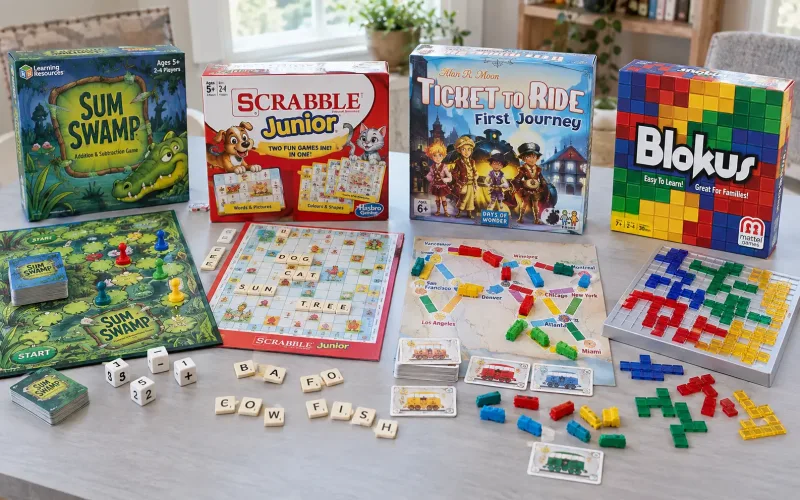
Best Educational Board Games for Ages 5 to 8
Children in early elementary school are usually ready for games involving basic reading, arithmetic, planning, and longer sequences of play. This age group benefits from games that reinforce classroom skills while still leaving plenty of room for luck and laughter.
Sum Swamp
Sum Swamp turns addition and subtraction practice into a journey through a colorful swamp. Players roll number and operation dice, solve the equation, and move the appropriate number of spaces.
The game is recommended for ages five and older and works especially well for children beginning to solve simple equations. It reinforces addition, subtraction, number recognition, and the difference between even and odd numbers. The American Academy of Pediatrics also recognizes that board games can provide enjoyable math practice.
Scrabble Junior
Scrabble Junior adapts the traditional word game for children who are still building their reading and spelling skills. The double-sided board offers a simpler picture-and-letter matching game on one side and a more open-ended word-building game on the other.
Beginning players complete words already printed on the board. As their skills improve, they can flip the board and create words independently. This two-level design gives the game more lasting value than a version intended for only one narrow reading stage.
Ticket to Ride: First Journey
Ticket to Ride: First Journey gives children a simplified introduction to the popular Ticket to Ride series. Players collect train cards, claim routes, and connect cities shown on their destination tickets.
The game is designed for ages six and older and typically takes between 15 and 30 minutes. Children practice planning routes, comparing options, recognizing locations, and adjusting their strategy when another player claims a needed path.
Blokus
Blokus has extremely simple placement rules but requires careful thinking. Players place geometric pieces on the board, with each new piece touching another piece of the same color only at the corners.
As the board fills, players must rotate pieces mentally, anticipate shrinking spaces, and decide when to block an opponent. The game supports spatial reasoning, geometry concepts, flexible thinking, and planning without requiring reading or math problems.
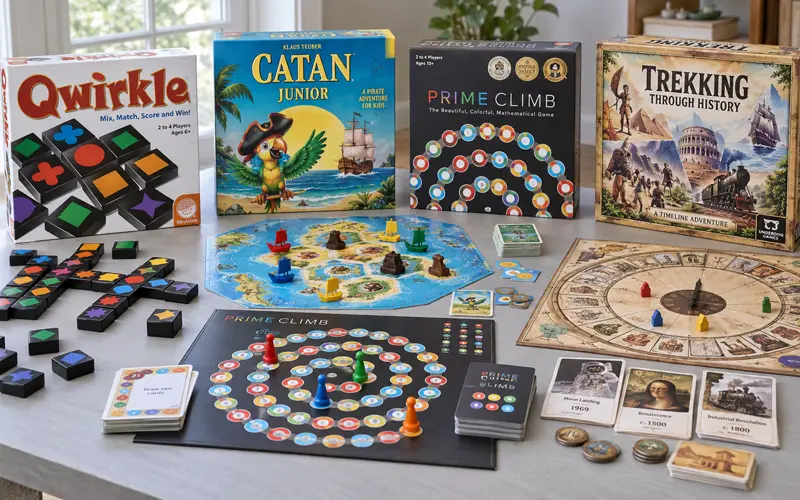
Best Educational Board Games for Ages 8 to 12
Older elementary and middle-school children can manage longer games, more detailed rules, and decisions that affect later turns. Educational board games for 8-, 10-, and 12-year-olds should offer enough strategy to remain interesting for adults as well.
Qwirkle
Qwirkle uses colorful wooden tiles with different shapes. Players create rows by matching colors or shapes while avoiding duplicate tiles within the same line.
The basic rules are easy to learn, but scoring well requires children to evaluate several possible moves and think ahead. Players practice pattern recognition, classification, spatial reasoning, arithmetic, and strategy.
CATAN Junior
CATAN Junior introduces children to resource collection, trading, and strategic building through a pirate-themed version of CATAN. Players collect materials, build ships, and establish pirate lairs on different islands.
Designed for ages six and older, the game uses simplified trading and building rules while preserving meaningful decisions. Players must decide how to use limited resources and adjust their plans based on what becomes available.
Prime Climb
Prime Climb is a colorful math game created for ages 10 and older, although children around eight may be able to play with adult guidance. Players use addition, subtraction, multiplication, and division to move their pawns toward the center of the board.
The board’s color-coding helps children visualize factors and prime-number relationships. It provides genuine math practice, but the strategic choices and unpredictable card effects keep it from feeling like a set of flash cards.
Trekking Through History
Trekking Through History takes players on a three-day journey through thousands of years of notable people, discoveries, and events. Players arrange historical event cards chronologically while managing time and collecting experience tokens.
The game includes 108 historical events and was developed for families with children ages 10 and older. A typical game lasts approximately 45 minutes. The illustrated cards can prompt further conversations about unfamiliar people, cultures, inventions, and moments in history.
How to Choose an Educational Board Game
A game does not need to cover every academic subject to be worthwhile. Choosing one that suits the child’s current abilities and interests is more important than selecting the game with the longest list of educational claims.
Consider the following factors before buying:
- Age and reading level: The manufacturer’s suggested age is a starting point, but children’s reading ability, attention span, and gaming experience also matter.
- Primary skill: Choose reading games for vocabulary practice, math games for number fluency, or strategy games for planning and problem-solving.
- Playing time: A 15-minute game may be a better choice for younger children than one requiring an hour of concentration.
- Number of players: Confirm that the game works with the number of people who will usually play.
- Level of adult involvement: Some games allow children to play independently, while others are more enjoyable with an adult helping explain rules and guide early turns.
- Replay value: Variable boards, different cards, strategic decisions, and multiple difficulty levels help prevent a game from becoming repetitive.
Children who enjoy building and experimenting may also respond well to hands-on electronic projects for kids, while children who prefer words may be more interested in spelling, storytelling, or vocabulary games.
Making Family Game Night Enjoyable
The educational value of a game disappears quickly if children view playing it as mandatory schoolwork. Introduce one new game at a time, explain only the rules needed to begin, and let children learn the remaining details as they play.
It also helps to give children some control. Let them choose the game, organize the pieces, keep score, or explain the rules once they understand them. Those responsibilities strengthen confidence and make game night feel like a shared family activity.
Keep the first few sessions short, especially when playing with younger children. Ending while everyone is still having fun creates a better experience than continuing until attention spans disappear. On trips, compact cards and familiar verbal games can complement family games for a road trip that require little or no equipment.
Learning That Feels Like Play
The best educational board games for kids balance learning with entertainment. Children may practice math, reading, geography, logic, and history, but they are also learning how to take turns, communicate, solve disagreements, and handle both winning and losing.
A well-chosen game can become part of family nights, rainy afternoons, holiday gatherings, and screen-free summer activities. When children ask to play again, the learning continues naturally, which is what makes an educational game successful.