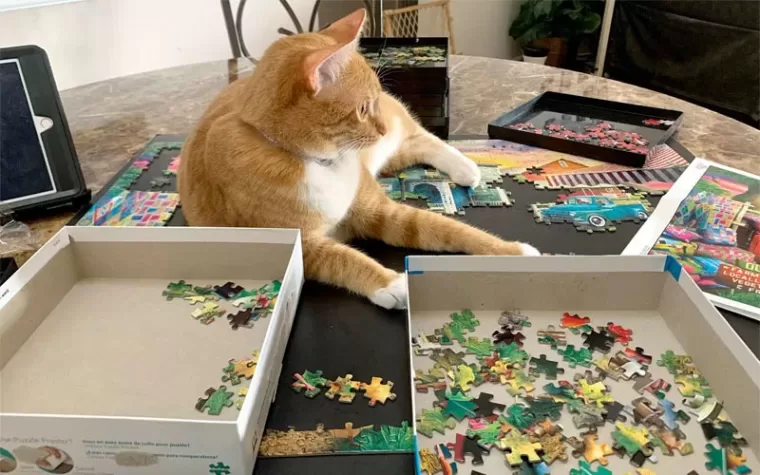
Puzzles have always been a relaxing and enjoyable activity for me. That was until our family of five with one dog became a family of five with two dogs and two cats. Suddenly, my odds of actually finishing a puzzle dropped dramatically.
The cat would innocently walk across the puzzle, stretch out on top of it, or bat a piece around like a toy. Eventually, one or two pieces would end up on the floor, and small, colorful, oddly shaped pieces of cardboard are pretty hard for dogs to resist. In just the last couple of months, I had to throw out five puzzles because one or more pieces went missing. There is nothing more frustrating than getting to the end of a puzzle and realizing a piece is gone.
I needed a simple way to keep cats off puzzles without packing everything away every time I wanted to take a break.
So, I went on a mission to figure out how I could still enjoy a puzzle from the very first piece to the satisfying last piece. I searched Amazon for puzzle storage options, but nothing seemed to fit my needs.
Possible Ways to Keep Cats Off Puzzles
Before coming up with my own solution, I looked at a few different puzzle storage options to see if one would work for our house.
- Puzzle Mat: A puzzle mat sounded helpful at first, but it didn’t seem sturdy enough to keep everything together the way I wanted. I also didn’t love the idea of rolling up my puzzle every time I needed to protect it from the cats.
- Puzzle Candy: I thought this might be the best option because it zips closed and covers the puzzle. After reading more about it, though, I wasn’t thrilled with the idea of working on a puzzle on a softer surface.
- Puzzle Board: A puzzle board solved part of the problem because there is no rolling and no soft surface. The downside is that most puzzle boards do not come with a cover. They may be great for moving a puzzle, but they did not fully protect the pieces from our four-legged family members. Some of them can also be pretty pricey.
A Better Way to Keep Cats Off Puzzles
Another drawback to most of the puzzle storage options I found is that they are usually made for 1,000-piece puzzles. While I often do 1,000-piece puzzles, I also enjoy working on 2,000-piece puzzles, and many of those options would not fit a puzzle that size.
I decided to take the best parts of the options I liked and create my own cat-proof puzzle setup.
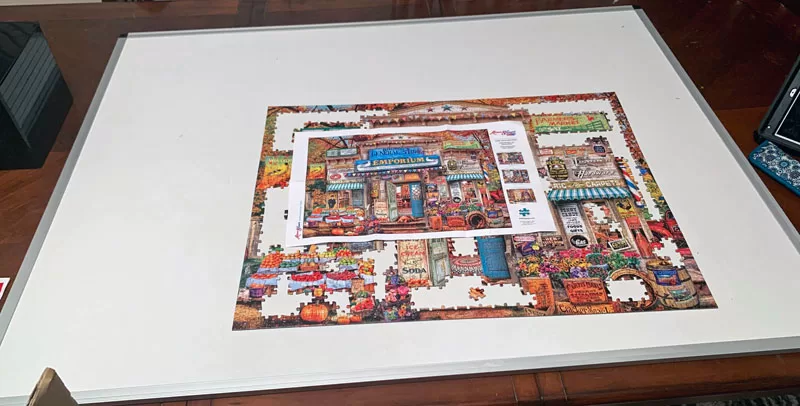
I purchased this board from Amazon.It is 48 x 36 inches, which is large enough for most puzzles and gave me a sturdy surface to work on. However, I still needed a way to keep the puzzle covered when I wasn’t using it.
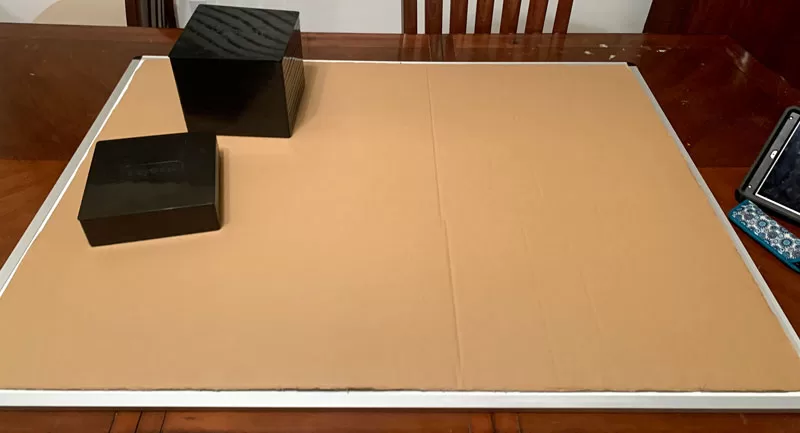
At first, I considered using poster board or fabric. Then it dawned on me that I could recycle the product packaging. I used the cardboard packaging and cut out a rectangle that fit just inside the aluminum frame of the board.
This was intentional. The cover does not lay over the entire board, which would make it easier to slide around. Instead, it sits just inside the frame, so if it shifts, it hits the frame and stays in place.
Why This Cat-Proof Puzzle Board Works
This cat-proof puzzle board works because it gives me the sturdy surface I wanted without forcing me to put the puzzle away every time I take a break. The board is large enough for most of the puzzles I enjoy, including many 1,000-piece and 2,000-piece puzzles, so I am not limited to smaller puzzle sizes.
The cardboard cover is what makes the setup work for our house. Since it fits inside the frame of the board, it stays in place better than a loose cover placed over the top. If one of the cats jumps up or decides to sit on it, the cover protects the puzzle underneath without sliding all over the place.
It also helps keep the dogs from getting involved. If the cats can’t knock loose pieces onto the floor, the dogs don’t have little cardboard puzzle pieces to find and chew. It is simple, inexpensive, and has made it much easier to enjoy puzzles again without worrying every time I walk away.
Quick Tips to Keep Puzzle Pieces Safe Around Cats
- Cover the puzzle anytime you walk away. Even a short break is long enough for a curious cat to jump up and move pieces around.
- Keep loose pieces in the box or a small container. This helps prevent stray pieces from ending up on the floor where pets can find them.
- Move edge pieces away from the sides. Pieces near the edge of the board are easier for cats to knock off.
- Use a sturdy surface instead of a soft mat. If your cat likes to walk across your puzzle, a firm board gives you a more stable place to work.
- Make sure the cover fits snugly. A cover that sits securely inside the frame is less likely to slide around if a cat jumps on top.
Enjoying Puzzles Again With Pets in the House
Now I can finally enjoy working on puzzles again without feeling like I have to finish the whole thing in one sitting. This setup has been an easy way to protect my puzzle from curious cats and keep loose pieces away from the dogs. It may not be fancy, but it works, and that is exactly what I needed.